
Japanese Currency and Other Money Matters in Japan
Exchange Rates
JP Yen Exchange Rate
https://www.x-rates.com/d/JPY/table.html
FX Rate : Japanese Yen
https://fx-rate.net/JPY/
The Japanese Yen
The Currency of Japan is Yen ¥. There are 1000, 5000, and 10000 paper bills and coins in 1, 5, 10, 50, 100, and 500 yen denominations.
*There is also 2000 Yen bill, but they are no longer printed and are rarely used.
In June 2024, the design of paper bills was changed. The new bills display their value in numbers, allowing non-Japanese speakers to easily distinguish them. Both the new and old bills can now be used.

10000 JP Yen
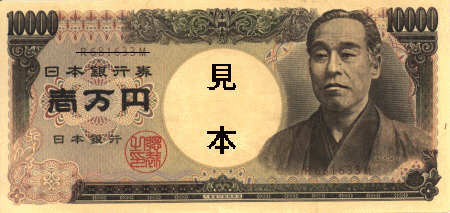
Old 10000 JP Yen
Japan is still in the process of transitioning to an entire e-cash society.
Large department stores, hotels, and most shops in the urban area accept payments by e-money and credit cards, but businesses in the local area may only accept payments by cash or Japanese credit cards.
Japanese Consumption Tax
The Japanese consumption tax (JCT) is similar to VAT (Value Added Tax) or GST (Goods and Services Tax). The JCT rate is 10% for most products and services, except for food and beverages, which are taxed at 8%.
Tips and Tipping
Tipping for a purchased service is not customary and not expected in Japan.
ATM's and Access to Cash (Yen)
Recently, the number of ATMs available in town has decreased. Instead, convenience stores, like Seven-Eleven, now have cash withdrawal machines for obtaining cash. In addition, convenience stores offer multiple payment options, allowing customers to pay in various ways, not just with cash. Post offices may have international ATM machines with instructions in English. ATMs can also be found at major Hotels and larger department stores.
EPS (Electronic Payment Systems) in Japan
Smart cards – Suica, PASMO、Kitaca、TOICA、ICOCA、SUGOCA、nimoca
These train cards are basically used to pay fares, but they can also be used to pay at stores, kiosks, and convenience stores.
This type of train cards is locally issued by major railway companies or e-card companies in the region. The usable smart cards in Tokyo area are Suica and Pasmo. If you have one of these cards, you can pay fares to take the most of transportations in Tokyo, including trains, subways and even busses, without buying a ticket.
Suica or PASUMO can be purchased from a ticket vending machine at a ticket office in a train station. You can charge money to your card by the ticket vending machine too. As for mobile Suica PASMO you can charge money on the app.
Train cards in different regions are now interoperable, allowing you to use a single card in various areas without needing separate cards for each location. For instance, if you have a Suica card issued by JR East in Tokyo, you can also use it in Osaka, which is part of the Kansai area. Similarly, if you have an ICOCA card issued by JR West in Osaka, you can use it in the Tokyo area, which is in the Kanto region, and vice versa.
Suica (Tokyo and Kanto Region)
https://www.jreast.co.jp/e/pass/suica.html
Pasmo(Tokyo and Kanto Region)
https://www.pasmo.co.jp/en/
Kitaka (Hokkaido Region)
https://www.jrhokkaido.co.jp/kitaca/
TOICA (Tokai Region)
https://toica.jr-central.co.jp/
ICOCA (Kansai Region)
https://www.jr-odekake.net/icoca/
SUGOCA (Kyushu Region)
https://www.jrkyushu.co.jp/english/sugoca.html
nimoca (For local transportations in Kyusyu region)
https://www.nimoca.jp/
